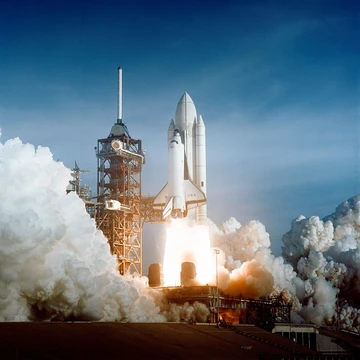
The Space Shuttle program
First reusable crewed space vehicle, flown 1981–2011.

The Space Shuttle program was the fourth human spaceflight program carried out by the U.S. National Aeronautics and Space Administration (NASA), which accomplished routine transportation for Earth-to-orbit crew and cargo from 1981 to 2011. Its official program name was carried over from the 1969 plan for the Space Transportation System (STS) of reusable spacecraft. Only the shuttle and supporting rockets were funded for development; a proposed nuclear lunar shuttle in the plan was canceled in 1972. It flew 135 missions and carried 355 astronauts from 16 countries, many on multiple trips. The Shuttle is the only winged crewed spacecraft to have achieved orbit and landing, and the first reusable crewed space vehicle that made multiple flights into orbit.
- Program start
- 1972
- First orbital flight
- April 12, 1981 (STS-1)
- Last flight
- July 2011 (STS-135)
- Total missions
- 135
- Astronauts carried
- 355 from 16 countries
- Orbiters built
- 5 (Columbia, Challenger, Discovery, Atlantis, Endeavour)
- Fatal accidents
- 2 (Challenger 1986, Columbia 2003)
Lore & Background
The Space Shuttle program finished with its last mission, STS-135 flown by Atlantis, in July 2011, retiring the final Shuttle in the fleet. The Space Shuttle program formally ended on August 31, 2011. In the course of 135 missions flown, two orbiters (Columbia and Challenger) suffered catastrophic accidents, with the loss of all crew members, totaling 14 astronauts.
Reader's Guide
The Space Shuttle program's significance lies in its role as the first reusable crewed space vehicle, enabling routine access to low Earth orbit for crew and cargo over three decades. It carried large payloads to various orbits, including components of the International Space Station, and performed service missions on the Hubble Space Telescope. The program also recovered satellites and other payloads from orbit, though this was rare. The total cost of the actual 30-year service life through 2011, adjusted for inflation, was $196 billion. The program's legacy includes its contributions to space station construction, satellite deployment, and scientific research, as well as lessons learned from its two fatal accidents. Since its retirement in 2011, many of its duties have been taken over by government and private vessels, including the Russian Soyuz, SpaceX's Dragon 2, and the uncrewed X-37B.
Did You Know?
- The Space Shuttle program flew 135 missions and carried 355 astronauts from 16 countries.
- The Shuttle is the only winged crewed spacecraft to have achieved orbit and landing.
- Two orbiters (Columbia and Challenger) suffered catastrophic accidents, with the loss of 14 astronauts total.
- The longest Shuttle mission was STS-80 lasting 17 days, 15 hours.
Frequently Asked Questions
Who is The Space Shuttle program?
The Space Shuttle program was NASA's fourth crewed spaceflight initiative, operating from 1981 to 2011 as the world's first reusable crewed spacecraft system. It provided routine Earth-to-orbit transport of astronauts and cargo for three decades.
What are The Space Shuttle program's powers/role?
Its core capability was launching a winged orbiter with a large payload bay, enabling satellite deployment, Hubble Space Telescope servicing, and International Space Station assembly. Over 135 flights it carried 355 astronauts from 16 nations into orbit.
How does The Space Shuttle program's story end?
The program closed with STS-135 in July 2011, when Atlantis completed its final mission and touched down at Kennedy Space Center. That landing marked the end of a 30-year stretch of American crewed orbital operations.
Why is The Space Shuttle program important?
As the first reusable crewed vehicle, it proved a spacecraft could be flown repeatedly rather than discarded after one trip, reshaping how humanity accessed orbit. It also constructed the International Space Station and kept Hubble operational, setting the stage for modern exploration.
What orbiters made up The Space Shuttle program?
Five orbiters were built: Columbia, Challenger, Discovery, Atlantis, and Endeavour. Columbia and Challenger were lost in accidents in 1981 and 1986, while the remaining three carried the program through its final missions.
More in Space Missions 1-22
Spotted an error? Know more?
This is a living reference — every entry is fact-audited, and reader corrections feed straight into our audit queue. Suggest an edit · See this site's audit record